The CS Leadership Academy

Build and Scale a Revenue-Generating CS Department

Get the proven framework built on behavioral psychology so that it works in the real world, not just on paper.

It tells you every step you need to build and scale a CS department, build a high-performing team, and get recognized by leadership. And it keeps getting CS leaders promoted…

See If It’s a Fit

Takes 2 minutes. Not a commitment — no pressure, no sales call. We just want to understand where you are so we can make sure it’s the right fit.

Rachel Provan
250+ Graduates
1 in 3 Promoted Within 6 Months
12 Weeks

The Job Has Never Been Harder

Expectations are higher than they’ve ever been. CS is being held responsible for retention and expansion, often without the data, headcount, or resources to actually deliver. And talented CS leaders are getting laid off for failing at tasks that were impossible to begin with.

If you’re worried about your job security — or your relevance — that’s a reasonable response to what’s happening right now.

Here’s what makes this harder than it should be.

You probably got promoted to leadership because you were great with customers. Not because someone taught you how to set strategy, manage a team, or make executives care about CS. That’s a completely different skillset — and almost no one teaches it.

So you’re figuring it out as you go. Working harder than anyone around you. Sitting in back-to-back meetings, putting out fires, trying to carve out time for the strategic work that never quite happens. And wondering if you’re the problem.

You’re not the problem. Your system just isn’t working for you.

The leaders who are thriving right now don’t just know CS strategy. They understand human behavior — and how to get customers, colleagues, and the C-Suite to do what you want.

How to motivate their team, how to communicate with executives in language that lands, and how to build a department that proves its value without having to fight for it in every meeting. Because you can have the best strategy in the world — and you won’t be able to roll it out unless you know how to get people at all levels to listen to you.

That’s exactly what you’ll learn in this signature program. How to build a revenue-generating CS department that actually works in the real world, because it’s based on human behavior. Not just what looks right on paper.

Introducing

The CS Leadership Academy

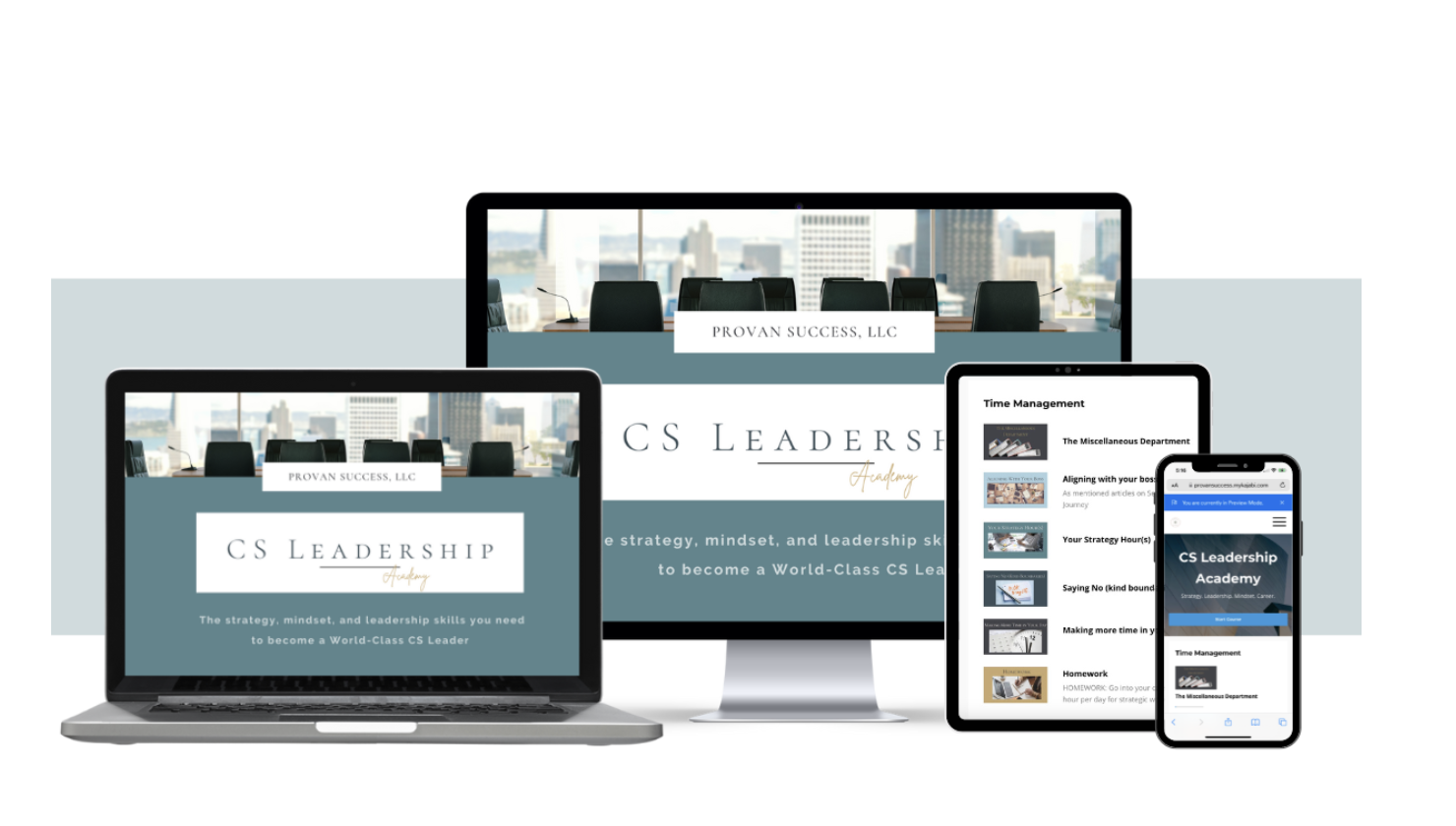
The CS Leadership Academy course shown on laptop, desktop, tablet, and phone
Trusted by CS leaders at

What the CS Leadership Academy Is

A 12-week program that gives CS leaders a step-by-step system — built on behavioral psychology and neuroscience — for building a revenue-generating CS department and getting recognized for it. It covers five areas:

1

Time Management

Get back 5–10 hours a week. Learn to set boundaries without burning bridges and stop spending every day in firefighting mode.

2

CS Strategy

The House of CS Maturity Model — a proven system for building and scaling a CS department step by step through four maturity stages. You’ll know exactly where your department is, what to build next, and how to explain that to the C-suite in a way they actually understand.

3

Communication & Influence

The psychological frameworks behind getting Sales and Product to stop causing the churn you get blamed for — and getting executives to see CS as mission-critical, not just a nice to have.

4

Leadership

How to coach your team instead of redoing their work. How to delegate, manage performance, and stop being the bottleneck — so you can finally lead instead of just firefight.

5

Mindset

Eliminate imposter syndrome and build executive presence — that still feels authentic — using tools from cognitive behavioral therapy and neuroscience.

Kristi Faltorusso

“Rachel gets what most CS leadership trainings miss. You can’t lead a team effectively if you’re drowning. You can’t prove CS value if you don’t know how to talk about it in a way that executives actually care about. The CS Leadership Academy covers all the stuff that matters.”

Kristi Faltorusso

What Happens After

Over one third of CS Leadership Academy graduates get promoted within six months — many to Director or VP level, even when no open role existed before they started.

Phoebe Vollers

“We’ve beaten our churn target five quarters in a row, and our NRR keeps climbing.”

Phoebe Vollers

Director of Customer Success

Rachel Askin

“It was like an MBA for Customer Success — I was able to pitch myself confidently and land a Director role.”

Rachel Askin

Director of Customer Success

Rachel Provan

About Rachel

Rachel Provan has been a CS leader for over 15 years. She’s built and scaled CS departments at companies from seed stage to Fortune 500 — across industries, business models, and market conditions. Her method works on repeat because it’s built on behavioral psychology, not on what happened to work at one company at one point in time.

She’s recognized as a Top 100 CS Strategist and has been featured in Gainsight Pulse, CS Insider, Calendly, and more.

She’s also in the CS Leadership Academy community every single day — not just on weekly calls.

Top 100 CS Strategist 250+ Graduates Podcast Host

Is This Right for You?

This Is For You If...

✓

You’re a Team Lead, Manager, Director, Head of CS, or VP who sets strategy and/or manages others

✓

You’re building or scaling a revenue-generating CS department

✓

You’re a Founding CSM building a CS department from scratch

✓

You want to build a department that runs without you in every call and escalation

This Is Not For You If...

✗

You’re brand new to CS or not yet responsible for strategy or managing others

✗

You’re looking for quick wins without putting in the work

And if you’re a Founding CSM — don’t let anyone tell you you’re not the head of CS. You belong here too.

Questions CS Leaders Ask

Is the CS Leadership Academy right for me?
It’s built for Customer Success leaders — team leads, managers, directors, VPs — being asked to build or scale a revenue-generating CS function without a playbook, a budget, or anyone above them who’s done it before. If you got promoted out of a CSM seat and you’re figuring out leadership as you go, you’re exactly who this is for. If you’re looking for how to be a better CSM — this isn’t it. But if you’re a CS leader, or ready to become one, this is where you’ll get the exact blueprint.
I’m already drowning. How will I have time for this?
All CS leaders are swamped. That’s why the first thing you learn is how to create more time in your day for strategic work — while still managing all the chaos that flies at you throughout the day. (And no, you won’t have to work overtime.) Most CS leaders are buried in firefighting, promising themselves they’ll get strategic “once things calm down” — and things never calm down. This is built for people who are slammed: you bring your real situations, and the work is designed to pull you out of the weeds, not pile more on top.
How is this different from every other CS leadership program out there?
Most CS training hands you frameworks and assumes customers and colleagues will just… follow them. They don’t. The whole Academy is built on behavioral psychology — how humans actually make decisions, prioritize, and get influenced — applied to Customer Success and leadership in everyday language. That’s the difference: strategy that accounts for how people really behave, so it works in the real world — not just on paper.
Does it actually work?
Over 250 people have been through it, and more than a third were promoted within 6–12 months of finishing. But the shift most people name first is the confidence they have in actually leading — influencing their exec team, tying their work to revenue, and building something instead of reacting all day.
What do I actually get?
Twelve weeks of live group coaching across everything the job really requires — strategy, time management, cross-functional influence, team leadership, and mindset — because missing any one of them is where the whole thing breaks down. You also get six months of support, plus AI prompts and strategies built right into the course so you can move faster.

What Happens When You Apply

This is not a commitment. You’re not agreeing to anything by applying, and you won’t be pressured to get on a call.

The application takes about 2 minutes. It helps us understand where you are and what you’re working on so we can make sure this is genuinely the right fit. We will send a couple emails and give you more info, including what you get, pricing, and what to do next.

We review applications on a rolling basis and accept 5–8 new students per month.

See If It’s a Fit

Takes about 2 minutes. No commitment required.