Learn the proven system to go from overlooked employee to respected leader.
Even if there are no open roles.
Takes 2 minutes. No commitment, no pressure, no sales call. We just want to understand where you are so we can make sure it's the right fit.
Real people, not case studies. They're running CS teams now — and most of them were exactly where you are.
Sr. CSM → VP in under two years
"I got promoted twice in just under two years, from Sr. CSM to VP. Now I'm on the Executive Team. It wouldn't have happened without The CS Leadership Academy."
Jessica Szivos
VP of Customer Success, Invisory
You're hitting your numbers. You're saving accounts, picking up the slack, saying yes to everything that lands on your plate. At this point you're probably doing twice the work you were originally hired to do — and your title and your pay haven't moved.
Maybe you've asked about next steps and been told, "There's no open role right now, just keep doing what you're doing." Maybe you've watched someone less experienced get promoted ahead of you and you genuinely can't figure out why. Either way, the path you assumed would open up for you just... hasn't. Not yet.
And the longer it goes on, the more it starts to get to you.
Is my income just capped here? Am I not "leadership material"? What am I doing wrong?
Here's what I want you to know before we go any further: it's not you. And it's not your effort. But the reason you're stuck is probably not what you think it is.
Because as much as they might like you, promoting you might actually hurt their metrics.
When you're great at your job, what happens if you move up? Who's going to fill that role? Someone not as good? Then what happens to the team's numbers, and your boss's KPIs?
Right now, your company already has exactly what they want — a CSM who delivers great results consistently. So why would they change that?
If you've tried to get promoted and struggled, you were probably making the most common mistake without realizing it.
You're making the promotion all about YOU, and what you deserve. Which, by the way, is COMPLETELY NORMAL. No one teaches you this stuff. There's no Promotions 101 in college.
Your company doesn't owe you a promotion for working hard.
You'll only get promoted when you can prove one thing: that they'll make more money with you in a leadership role than they will with you as a CSM.
The part nobody teaches you
If the term is unfamiliar, a business case is just a formalized way of explaining why doing something would benefit the company. It's what your VP puts together when they want budget for a new tool, or what your CFO wants to see before approving a hire. Nobody ever hands you one for your own career.
It isn't a reward for effort, and it isn't a gold star for loyalty. It's an argument, made in their numbers, that the company will make more money with you leading a team than with you running your own book of business. More revenue, better margins, more efficiency.
Companies don't need an open spot on the org chart, and they don't care what's happening in the economy. If they know promoting you will make them more money, they'll find a way.
That's the honest reaction almost everyone has. And you're right that you can't just claim it. Nobody gets promoted on a hunch or a nice story. You get promoted when you can show it in their numbers, the ones already sitting in their systems.
You don't have to become some hybrid of a CFO and a sales superstar to do that. You learn which parts of your work actually move revenue, retention, and margin, and not just inside your own book of business. Then you learn to translate that into the metrics your executives already track and already care about.
What they usually hear
A request
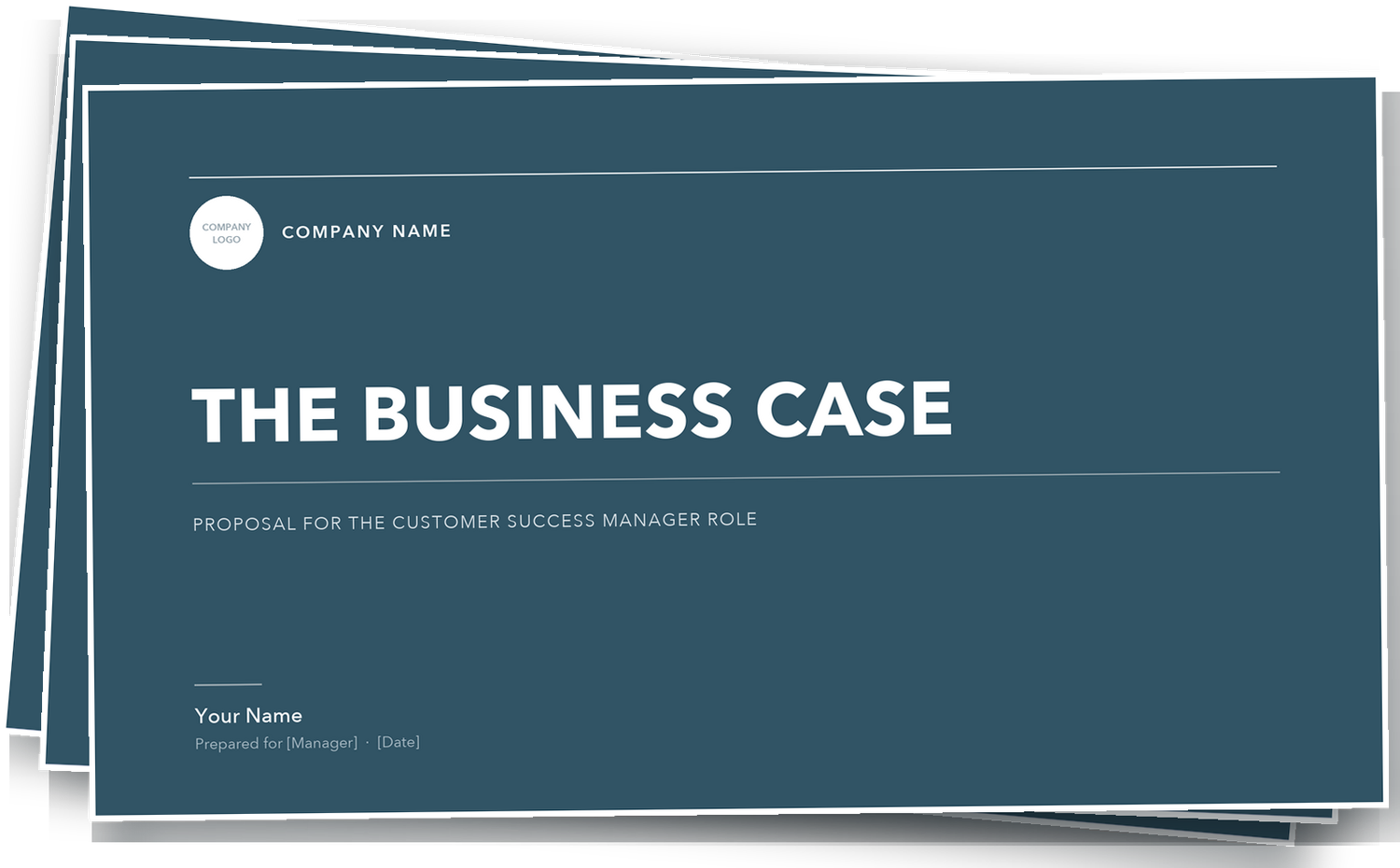
A decisionThe presentation template you fill in inside the Academy, built in their numbers.
You track it, you build the argument, and you present it. And the case for your promotion stops being about you and what you deserve. It becomes a business decision, based on math they can't argue with.
Being a CS leader is a completely different job. The average new CS leader lasts nine months in their first role — because most of them got promoted without learning how to actually do it. So if you want the promotion to stick, you have to learn the job before you step into it.
And you can't build that case out of thin air. The numbers have to come from real work: the retention, expansion, and revenue a leader is responsible for, not just your own book of business. Which means learning the leader's job and doing it from where you sit, before anyone hands you the title.
That's the part that trips almost everyone up. But there's a way to do all of this so that your boss benefits too, instead of feeling like you're coming for their job.
This is what The CS Leadership Academy gives you:
The skills to do the job.
The proof you can.
And the proven framework to make promoting you the obvious business decision.
Curious whether this is the right fit for where you are?
See If It's a FitTakes about 2 minutes. No commitment, no sales call.
You're a CSM or Senior CSM who wants to move into CS leadership
You're driving real results — retention, expansion, adoption — and tired of watching the title and pay go to someone else
You're ready to learn how to actually do the leader's job, not just work harder at your current one
You'd rather build the business case for your promotion than keep hoping someone notices
You're brand new to CS and not yet doing the core CSM work
You want the title without learning to do the job
You're not willing to invest the time the program requires
And if there's no CS leader above you to learn from, that's okay. We give you the playbooks, templates, and strategies you'd otherwise spend years piecing together on your own.
That's why the Promotion Playbook sits at the center of everything you do inside the Academy. It's the exact system I used to get promoted five times in eight years — and that my clients have used to get promoted to Manager, Director, and VP.
You fill in the blanks. And it works even when there's no open role — because the company will create one.
Ready to build the case that makes promoting you the obvious decision?
Apply NowWe accept just 5 to 8 new students per month.
The Curriculum
The CS Leadership Academy is a 12-week program built on CS strategy, behavioral psychology, and neuroscience — so it's not just theory. It works in real companies, where CS isn't always the top priority.
The House of CS Maturity Model. A step-by-step system for building and scaling a revenue-generating CS department through four stages — from reactive firefighting to predictable, positive NRR.
You walk into the promotion conversation able to show exactly where the department is and what to build next. So you prove you can run it instead of just claiming you could.
The exact language to get Sales and Product to stop causing the churn you get blamed for — and get executives to see CS as essential, not just a nice-to-have.
How to coach, delegate, and manage performance instead of out-working everyone around you. You'll learn to lead before you're handed a team, so stepping into the role is earned, not a gamble.
The habits and mindset shifts that protect time for the work that grows NRR. Get back 5 to 10 hours a week while still managing your full workload. Operating like this is one of the clearest signals to leadership that you're ready to move up.
Eliminate imposter syndrome, perfectionism, and people-pleasing. Build executive presence that still feels like you — and develop the confidence that both you and the people around you can feel.
The model your CS strategy is built on. It lets you prove you can run a department before anyone hands you one — and most current CS leaders don't have it.
Where everyone starts. Information is siloed, so CSMs react to feedback as it comes in.
A CS tool is in place. CSMs track accounts across the lifecycle, with real visibility into the customer base.
The tool flags risks and opportunities, so CSMs stay ahead of their book of business.
A scaled, strategic program with predictable paths to customer outcomes and positive NRR.
Over 90% of graduates who finish the program and use the Promotion Playbook get promoted within six months — even when there was no open role before they started.
Where graduates are now

Ashley Watson
VP of Customer Success

Dan Weber
VP of Customer Success, Bamboo Rose

Adriana C
Head of Customer Success

Danielle Gilchrist
Sr Director, Customer Success

Walter Darrough
Director of Customer Success, Flexera

Christina Smigie
Director of Customer Success

Miriam M.
Director of Customer Success

Dan C
Director of Customer Success

Becca Keen
Manager, US Customer Success

Kerry C
Customer Success Leader


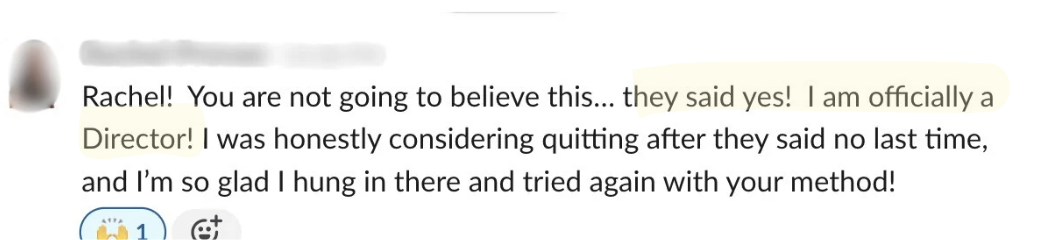
Real messages from our community — names hidden for privacy. We accept just 5 to 8 new students per month.
Rachel Provan has been a CS leader for over 15 years. She was promoted five times in eight years — then taught the people backfilling her old roles to do the same. She's built and scaled CS departments at companies from seed stage to Fortune 500, and her method works on repeat because it's built on behavioral psychology, not on what happened to work at one company at one point in time.
She's recognized as a Top 25 CS Strategist and has been featured in Inc. Magazine, Gainsight, Forrester, Calendly, and many more.
She's also in the CS Leadership Academy community, helping students every single day — not just on weekly calls.
This is not a commitment. You're not agreeing to anything by applying, and you won't be pressured to get on a call.
The application takes about 2 minutes. It helps us understand where you are and what you're working toward, so we can make sure this is genuinely the right fit. We'll send a couple of emails with more information — including what you get, pricing, and what to do next.
We review applications on a rolling basis and accept 5 to 8 new students per month.
Apply NowTakes about 2 minutes. No commitment required.